Name short
EN
Color
#083862
  • Finding Your Voice: PAOs, Advocacy, and Public Policy

    PAO Capacity Building Series

    The voice of your professional accountancy organization (PAO) matters.

    The accountancy profession is most successful and sustainable with the support of healthy national and regional professional accountancy organizations (PAOs) that have robust, effective relationships with their national and regional stakeholders, including government and regulators.

    The success of any PAO relies in large part on its ability to effectively communicate, and demonstrate, its relevance to society. This begins early in a PAO’s development with promotion of:

    IFAC
    English
  • Project and Investment Appraisal for Sustainable Value Creation

    International Good Practice Guidance

    This guidance was written for all organizations, regardless of their size or structure, private or public, to support the accountancy profession’s facilitation of sustainable organizations, financial markets, and economies by providing guiding principles to manage the complexities of performing a robust project and investment appraisal. Greater rigor in the appraisal and decision process can be achieved by using the principles as a benchmark against which to assess an organization’s current practice.

    IFAC
    English
  • Establishing Governance

    A Guide for Professional Accountancy Organizations

    A strong and well-governed professional accountancy organization (PAO) produces and sustains a strong accountancy profession that is able to serve the public interest and contribute to economic stability and growth. A successful PAO gains much of its strength from the sense of identity, benefits, and rights that members derive from membership; and from the contributions that individual members and firms make to the PAO in recognition of its public interest perspective.

    IFAC
    English
  • Guide to Quality Control for Small- and Medium-Sized Practices, Third Edition

    This third edition of the guide features enhancements to the two sample manuals, as well as other refinements for clarity and consistency with International Standard on Quality Control (ISQC) 1. The guide contains the requirements set out in ISQC 1 in addition to implementation guidance, including discussion material and an integrated case study that can be used as the basis for education and training.

    IFAC
    English
  • Taryn Rulton Named as IFAC’s Next President

    New York, NY English

    The International Federation of Accountants (IFAC), the voice of the global accountancy profession, has announced the election of Taryn Rulton as its President. Ms. Rulton will serve a two-year term through November 2028, having served previously as IFAC Deputy President since November 2024.

    “It is an honor to serve as IFAC President,” said Ms. Rulton. “Working with the IFAC Board, our members, and stakeholders around the world, I look forward to building on our work to advance the global accountancy profession in the public interest. Together, we will help the profession respond to change with confidence, embrace new opportunities, and continue to strengthen trusted and resilient businesses, institutions, and economies.”

    Ms. Rulton joined the IFAC Board in November 2020 and served as Deputy President from November 2024, having been nominated by Chartered Accountants Australia and New Zealand (CA ANZ) and CPA Australia. She has significant experience in corporate governance and standard setting, including two terms on the Australian Accounting Standards Board (AASB), and has served on multiple boards and committees across the not-for-profit and public sectors, including as Chair of Audit and Risk Committees.

    Ms. Rulton has more than 30 years of professional experience across Australia and the United Kingdom, spanning banking, Big Four firms KPMG and EY, government, private companies, non-governmental organizations, and universities. She is Chief Commercial Officer at La Trobe University in Melbourne, Australia.


    Kathryn Byrne Named IFAC Deputy President

    IFAC also announced the election of Kathryn Byrne as its Deputy President. Ms. Byrne joined the Board in November 2022. 

    Ms. Byrne has more than 30 years of professional experience and is currently a Partner at Forvis Mazars LLP. In her career, she has led a firm’s Philadelphia office, manufacturing and distribution sector, international services group, and Women’s group.

    Ms. Byrne brings extensive governance and international experience. She served on the Mazars Group Governance Council, including as Chair of its Risk Committee, and has held leadership roles with Praxity, including as North American Chair. She has also held the role of Independent Lead Director of a public company. Prior to joining the IFAC Board, she served on IFAC’s Nominating Committee and Compliance Advisory Panel, including as Chair of the Panel.


    New Board Members Elected

    IFAC also announced new and re-appointed Board members:

    New appointments:

    • Mr. Cédric Gelard (CNCC/CNOEC, France)
    • Mr. Prasanna D. Kumar (ICAI-Chartered, India)
    • Mr. John Palermo (CA ANZ, Australia)
    • Mr. Takuji Kanai (JICPA, Japan)

    Reappointments:

    • Mr. Khalillulah Shaikh (ICAP, Pakistan)

    Lee White, Chief Executive Officer, said: “I want to begin by expressing my heartfelt thanks to Jean Bouquot for his outstanding leadership, dedication, and unwavering commitment to IFAC and our members over the past two years. It has been a real privilege to work alongside Jean. I also want to extend my sincere appreciation to our outgoing Board members.

    I am absolutely delighted to welcome Taryn Rulton as our new President and Kathryn Byrne as our new Deputy President. Both bring tremendous experience, fresh perspectives, and a deep commitment to our profession and the public interest. I look forward to working closely with them, and with our new and reappointed Board members, as we continue to strengthen the global voice of our profession.

    At a time when the world is increasingly fragmented, our ability to come together as a global profession matters more than ever. I am excited about the journey ahead and what we can achieve together.”


    New IFAC Associates Admitted

    In addition to the election of new Board members, the IFAC Council also approved new Associate organizations.

    New Associates:

    • Ordre National des Experts Comptables du Congo (ONEC Congo)
    • Ordre National des Experts Comptables et Comptables Agrées du Niger (ONECCA Niger)
    • Association of International Accountants (AIA UK)

    The new appointments and membership admissions were approved at the 2026 IFAC Council hybrid meeting, with a physical location held in Seoul, South Korea on November 17, 2026.
     

    About IFAC

    IFAC, by connecting and uniting its members, makes the accountancy profession truly global.

    IFAC member organizations are champions of integrity and professional quality, and proudly carry their membership as a badge of international recognition.

    IFAC and its members work together with the Forum of Firms and other key stakeholders to shape the future of the profession through learning, innovation, a collective voice, and commitment to the public interest.

    Kathryn Byrne (AICPA, USA) Appointed Deputy President; New Board Members, Associate Organizations Approved

  • World Congress of Accountants 2026 Opens in Seoul with Focus on Economic Resilience and Global Cooperation

    Seoul, South Korea English

    The World Congress of Accountants (WCOA) 2026 opened today in Seoul, South Korea, bringing together leaders from the global accountancy profession and the wider financial ecosystem for three days of dialogue on the challenges and opportunities facing economies, institutions and the profession. Jointly hosted by the International Federation of Accountants (IFAC) and the Korean Institute of Certified Public Accountants (KICPA), the event is taking place November 17–19 under the theme “Together for a Connected Tomorrow.”

    The opening-day program put economic resilience, leadership through uncertainty and financial stability at the center of the conversation, highlighting the role of trusted institutions, professional judgment and international cooperation in navigating a changing global environment.

    In the keynote session “Building Competitive, Resilient Economies,” Shin Je-Yoon, Chairman of the Board & Independent Director of Samsung Electronics, addressed the forces affecting competitiveness and long-term growth amid geopolitical uncertainty and technological disruption. A leadership exchange, “Leading Without a Playbook,” brought together Alan Vallance of ICAEW, Dr. David Sun of the Accounting and Financial Reporting Council, and Megan Zietsman of Deloitte, moderated by IFAC Chief Executive Officer Lee White, to examine how leaders confront difficult decisions when established approaches no longer suffice.

    The afternoon also featured “The Future of Financial Stability,” a conversation with Steven Maijoor, Executive Board Member and Chair of Supervision of De Nederlandsche Bank, focused on the importance of resilient financial systems, trusted institutions and markets, and international cooperation in maintaining confidence and stability in an increasingly interconnected global economy.

    Woon Youl Choi, KICPA President, welcomed attendees, saying:

    “Korea’s own experience has taught us the value of trust. Seventy years ago, our economy was among the poorest in the world. Today it is one of the most dynamic. Investors had to trust the numbers, lenders had to trust the accounts, and accountants were there, quietly, at every step. When information moves faster than ever, trusted information becomes more valuable than ever. Our profession must remain the guardian of that trust. That is the spirit of our theme, ‘Together for a Connected Tomorrow’: no country can solve today’s challenges alone, and our most important task is to prepare the next generation of accountants.”

    Jean Bouquot, IFAC President, opened WCOA with a call to action:

    “At this World Congress, we have the chance not simply to hear about change, but to learn from one another about how we are responding to it. What is working? Where are we moving too slowly? And where can we achieve more together than we can alone? ... I have seen the outstanding commitment of this profession firsthand. It has made me optimistic, not because the challenges are small, but because accountants have repeatedly shown that we can adapt while upholding the principles that define us.”

    WCOA 2026 continues on November 18 with sessions on AI and digital transformation, the future of professional accountancy organizations, talent, standard setting and resilience in the global financial ecosystem. Virtual participants can follow main-stage programming through Whova, with recordings available following the event. Further information is available at ifac.org/wcoa.

    Image
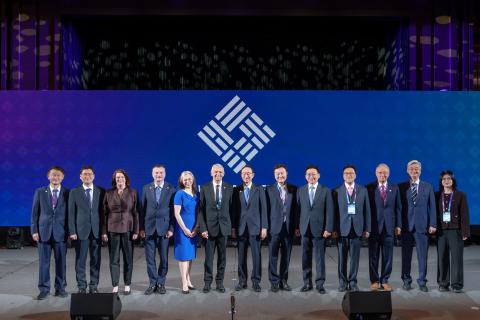
    the IFAC and KICPA leadership teams at the World Congress of Accountants 2026
    The IFAC and KICPA leadership teams at the World Congress of Accountants 2026. Seoul, South Korea, November 17 2026. Photo credit: KICPA/Ovation

    About IFAC

    IFAC, by connecting and uniting its members, makes the accountancy profession truly global. IFAC member organizations are champions of integrity and professional quality, and proudly carry their membership as a badge of international recognition. IFAC and its members work together with the Forum of Firms and other key stakeholders to shape the future of the profession through learning, innovation, a collective voice, and commitment to the public interest.

    About KICPA

    The Korean Institute of Certified Public Accountants (KICPA), established in 1954 under the Certified Public Accountants Act, is the statutory professional body representing Certified Public Accountants in Korea. KICPA works to build trust and transparency in Korea’s financial markets through professional standards, ethical conduct, and continuing professional development. KICPA is an IFAC member organization.

    Leaders from accountancy, business and financial institutions convene under the theme “Together for a Connected Tomorrow”