Strengthening PAOs Through Early-Career Professional Engagement
Early-career professionals are the future of the accounting profession. Yet too many feel disconnected from the very organizations that should be championing their development. For professional accountancy organizations (PAOs), this is not just a missed opportunity. It is a strategic risk to the leadership, relevance, and member commitment they depend on.
IFAC, Gavi, the Vaccine Alliance, and the Global Fund are working together to strengthen public financial management in the health sector by investing in the accountancy profession.
The initiative supports professional accountancy organizations as they build the skills, systems, and training pathways needed by accountants and finance personnel working in public health. Stronger financial management helps improve transparency, accountability, and the effective use of health funding.
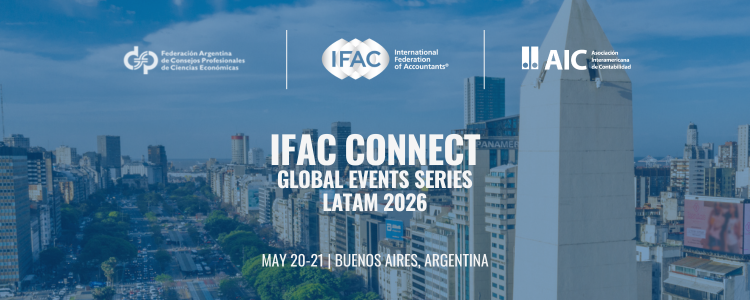
The International Federation of Accountants (IFAC) today opens IFAC Connect LATAM 2026 in Buenos Aires, Argentina bringing together regulators, standard setters, investors, business leaders, and professional accountancy organizations from across the globe and Latin America to strengthen trust, transparency, and resilience in the region’s economic and reporting ecosystem.
Amid geopolitical fragmentation, IFAC convenes these leaders to collaborate across jurisdictions and sectors to strengthen the profession, advance high-quality global standards, respond to risks and opportunities in emerging areas like AI, and drive long-term economic growth through local action.
The two-day event is held in collaboration with the Asociación Interamericana de Contabilidad (AIC) and IFAC member Federación Argentina de Consejos Profesionales de Ciencias Económicas (FACPCE).
Lee White, IFAC Chief Executive Officer, said:
“For an international organization like us, global impact depends on the strength, insights, and leadership of our regions. IFAC Connect LATAM is an important opportunity to listen closely to our members and stakeholders, understand the priorities shaping the profession across Latin America, and work together to mobilize the accountancy profession in support of trust, transparency, and sustainable economic growth. By connecting regional perspectives with global priorities, we can ensure the profession remains relevant, responsive, and united in serving the public interest.”
A major focus of the event is strengthening Latin America’s voice, coordination, and influence within the global reporting ecosystem.
Silvia Giordano, IFAC Board Member, said:
“Latin America is navigating significant economic and institutional transformation, and the accountancy profession plays a critical role in supporting integrity, governance, and long-term resilience during this period of change. I am especially proud that Argentina is hosting IFAC Connect LATAM in Buenos Aires, bringing together regional and global leaders to strengthen cooperation and advance solutions that serve the public interest.”
Jose Simonella, FACPCE President, said:
“By bringing together leaders from across the region and the international community, IFAC Connect strengthens dialogue, cooperation, and the profession’s ability to support resilient economies, trusted institutions, and sustainable growth.”
Nelson Hahn, AIC President, said:
“This gathering reflects the strength of regional collaboration and the profession’s shared commitment to advancing high-quality standards and professional excellence across Latin America. Through continued cooperation among jurisdictions and institutions, the profession is helping build stronger economies, more transparent organizations, and greater public trust.”
IFAC Connect LATAM 2026 is part of the ongoing IFAC Connect series launched in 2024, which brings together global and regional leaders to address the most pressing issues shaping the future of the profession in the public interest. The next IFAC Connect will be held in Algiers, Algeria in June.
About IFAC
IFAC, by connecting and uniting its members, makes the accountancy profession truly global.
IFAC member organizations are champions of integrity and professional quality, and proudly carry their membership as a badge of international recognition.
IFAC and its members work together to shape the future of the profession through learning, innovation, a collective voice, and commitment to the public interest.
About AIC
The Inter-American Accounting Association (AIC) is a non-profit civil organization, established in 1949 with the primary objective of uniting accountants throughout the Americas, undertaking the commitment to represent them within the hemisphere, and promoting the continuous enhancement of their professional quality, knowledge, and social responsibilities.
About FACPCE
The Federación Argentina de Consejos Profesionales de Ciencias Económicas (FACPCE) represents Argentina’s provincial professional councils in economic sciences and supports the development of the accountancy profession through professional excellence, ethical conduct, high-quality standards, and contributions to transparent and sustainable economic development.
Materiality is a fundamental concept in financial reporting, functioning as a filter that ensures the financial information provided is relevant for accountability purposes and useful for decision-making. Information is considered material if omitting it, misstating it, or obscuring it could influence decisions or accountability. In practice, however, applying this concept can be challenging, and some IPSASB stakeholders have used the disclosure requirements in IPSAS® Standards as a checklist rather than applying professional judgment.
Last year, the IPSASB conformed its definition of material. Now, the IPSASB’s proposed non-mandatory guidance in ED 97 aims to help preparers apply materiality more effectively when preparing financial statements under IPSAS Accounting Standards.
ED 97 describes a practical, four-step approach to identifying, assessing, organizing, and reviewing potential material information. The guidance does not change existing requirements but supports more consistent and informed application of materiality across IPSAS Standards.
“Materiality helps entities determine what information to include in or exclude from financial statements, and our proposed guidance in ED 97 provides a systematic approach to making such judgments,” said IPSASB Chair Thomas Müller-Marqués Berger. “We want to hear from our stakeholders if this guidance can help them make judgments more confidently and consistently in practice, and where additional clarity may be needed.”
The guidance was adapted by the IPSASB for public sector use from the IFRS® Practice Statement 2: Making Materiality Judgements. The IPSASB encourages input from preparers, auditors, and other stakeholders to ensure the final IPSAS Practice Statement reflects real-world application in public sector financial reporting.
The International Public Sector Accounting Standards Board (IPSASB®) works to improve public sector financial reporting worldwide through the development of IPSAS® Accounting Standards, IPSASB SRS™ Standards, and other high-quality financial reporting guidance for use by governments and other public sector entities. It also raises awareness of IPSAS Standards and IPSASB SRS Standards and promotes the adoption and implementation of these to enhance the quality and consistency of practice throughout the world and strengthen the transparency and accountability of public sector finances and sustainable development. The Board receives support from the Asian Development Bank, the Chartered Professional Accountants of Canada, the New Zealand External Reporting Board, the government of Canada, and The World Bank. The structures and processes that support the operations of the IPSASB are facilitated by the International Federation of Accountants (IFAC®). For copyright, trademark, and permissions information, please go to permissions or contact permissions@ifac.org.
About the Public Interest Committee
The governance and standard-setting activities of the IPSASB are overseen by the Public Interest Committee (PIC), to ensure that they follow due process and reflect the public interest. The PIC is comprised of individuals with expertise in public sector or financial reporting, and professional engagement in organizations that have an interest in promoting high-quality and internationally comparable financial information.